Classic Motorcycles
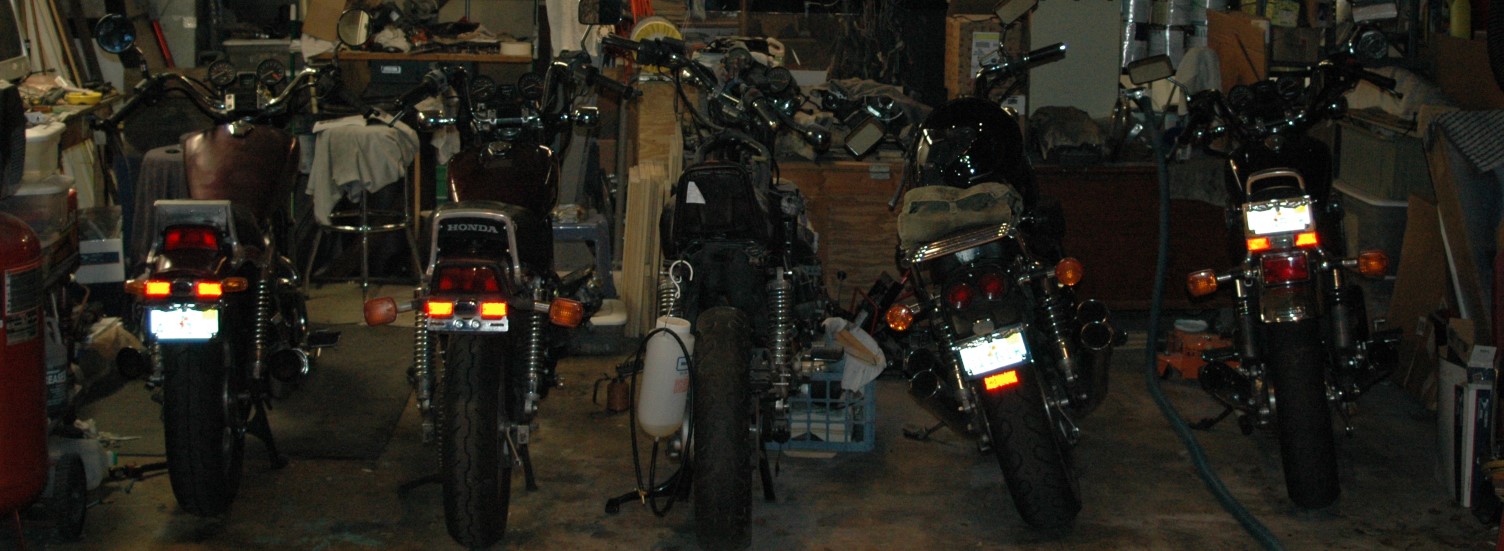
The reason to create the original Stew's Place site. The restoration of those original two two classic '83 Honda V4 Magna motorcycles, an '83 VF750C and an '83 VF1100C, took years. But it soon grew to be many more. An '85 VF500C. An '85 VT500C. And my favorite, an '87 VF700C SuperMagna. Even a dirt bike for Nick to tinker with! An '82 Suzuki RS175.
We made a great start, assembling the rolling frames of both originals from all the boxes of parts. Shop manuals were available on eBay, along with gasket sets and other assorted replacements parts, even specialty tools to remove the one of a kind "castellated" nuts, essentially a ring of metal with slots in place of hex flats.
Those special tools get real expensive real quick, so I made my own. By starting with the correct sized socket and cutting out the metal, leaving tabs in place to fit the slots, an effective tool results. But we'll save more of the details like that for later. Read all about it on the motorcycle projects page.
Classic Cars
The adventure begins with Ann buying a '98 Jeep Wrangler. It has its share of problems, but it's a Jeep, and it runs. At the time, I was not equipped to do the work that needed done, so we had to rely on a mechanic. He was able to fix a number of issues, but it was expensive, and it took time to find them all. Eventually it was handed down to our daughter. It came home one day with a knocking rod. Somehow it managed to run out of oil, even though we reminded her to check it with every fillup.
I counted on Nick's help to pull the engine. Still not equipped to drop the heavy skid plate out of the way to disconnect the transfer case and transmission mounts, we couldn't pull the engine and transmission together as a unit. We figured it would be less work to pull just the engine, but that proved to be as just much work. For whatever reason, the top two bolts were right up against the firewall and impossible to get to. To add insult to injury, they used specialty head 12 point bolts to boot! Even with the correct socket, there wasn't enough room to get on them and Nick ended up grinding the heads off!
That was only the start of getting that Jeep Wrangler back on the road again. Nick's sister had already got her own car, so the Jeep got handed down to Nick. He was certainly motivated to get her back together and up and running after we had the engine rebuilt. That certainly cost a pretty penny. Knowing then what we know now, we would have done things differently. Of course, now we have our own machine shop. I say we. It's really Nick's machine shop, at least, enough of one to mill and machine the parts we need. He even rebuilt a CNC mill with LinuxCNC, but we'll save details like that for later. Read all about it.
Renovations
We've always made renovations to our homes, starting with our first in Palm Bay, FL, back in the '80s. After my layoff in 1994, my "Christmas present" that year. We moved to the Orlando area after I found a much better paying job. The house in Wekiva Springs, FL, needed plenty of work though. We agreed to do it as part of a six month lease to buy option. The wood siding was rotted along the bottom all around the house, along with other areas that needed attention to pass the wood rot inspection. We made the deadline and the rest is history.
That was our home of twenty years. We made day trips to Mount Dora on the weekends to visit the Flea Market and the many antique shops. Another treat was riding the train that left from the downtown station. We'd browse the downtown shops and enjoy a meal at one of the many restaurants. At some point we knew we wanted to move there. We found a house and Ann fell in love with it, so we bought it. To say it was a "fixer upper" would be an understatement. We planned on spending weekends doing what needed done so we could take our time doing it before moving in.
Fate dealt us a different hand when a pipe burst and we had to move to Mount Dora sooner than planned. We ended up having to make those renovations while living in the house. It made it much more difficult to make those changes, having to plan around outages to avoid hotel stays and minimize the disruption to our lives. We were able to fix that burst pipe at the other house eventually. Our daughter and her husband rent it from us now. Enjoy our renovations and the rewards we enjoyed.
Model Railroads
As much as I'd like to figure out how to make my own stainless steel rail, as long as the hobby shop continues to stock the ten foot lengths of Piko flex track, I'll keep buying it. Even those once plentiful Aristocraft wide radius switches are no longer available, now pure unobtanium. That's next on the list. Trackage and turnouts.
My early experiments with 3D printing using PLA ended in failure. Basically, the plastic melted from the extreme heat of the metal rail baking in the Florida sun. I'll need more resilient material to print switch ties from. If I ever finish my designs that is... I plan to try using PETG next. If these terms sound foreign, they are acronyms for the chemicals that make up the plastic filament used in 3D printing.
We'll cover all those details and more on our Barkyard Blog. It deserves even more detail, and we'll have a dedicated page for it here soon to add to the castings page.